
Washington County Court Records After Arrest
A Washington County arrest can begin with a warrant, probable cause, a felony matter, a misdemeanor under Kansas arrest rules, or an offense seen by an officer. Booking at Washington County Jail is the custody step. Court records after a jail arrest begin when the case moves into the district court track and the prosecuting office files or reviews charges. The Washington County Attorney's Office is led by Elizabeth Baskerville Hiltgen and prosecutes felony, misdemeanor, traffic, fish and game, and juvenile offenses that occur in the county. That office also handles care and treatment cases, drug and alcohol commitments, post-conviction matters, and county-counselor duties.
The arrest label used during jail intake is not the same thing as a filed court charge. Booking information is useful for custody questions, and Sheriff Justin Cordry's office is the local custody contact, but the court record controls case number, formal charge wording, hearing dates, bond entries, disposition, and sentence. Current custody and booking status belong on the jail inmate records side of the process. Booking photos and Kansas mugshot access limits belong on the jail roster mugshots page. Court records after arrest should be checked after the charge has been filed or after the clerk has enough information to locate the case.
Process flow: Arrest, jail booking, first appearance, prosecutor review, filed charge, court case, hearings, disposition, and possible sentence or release.
Find Washington County Court Records
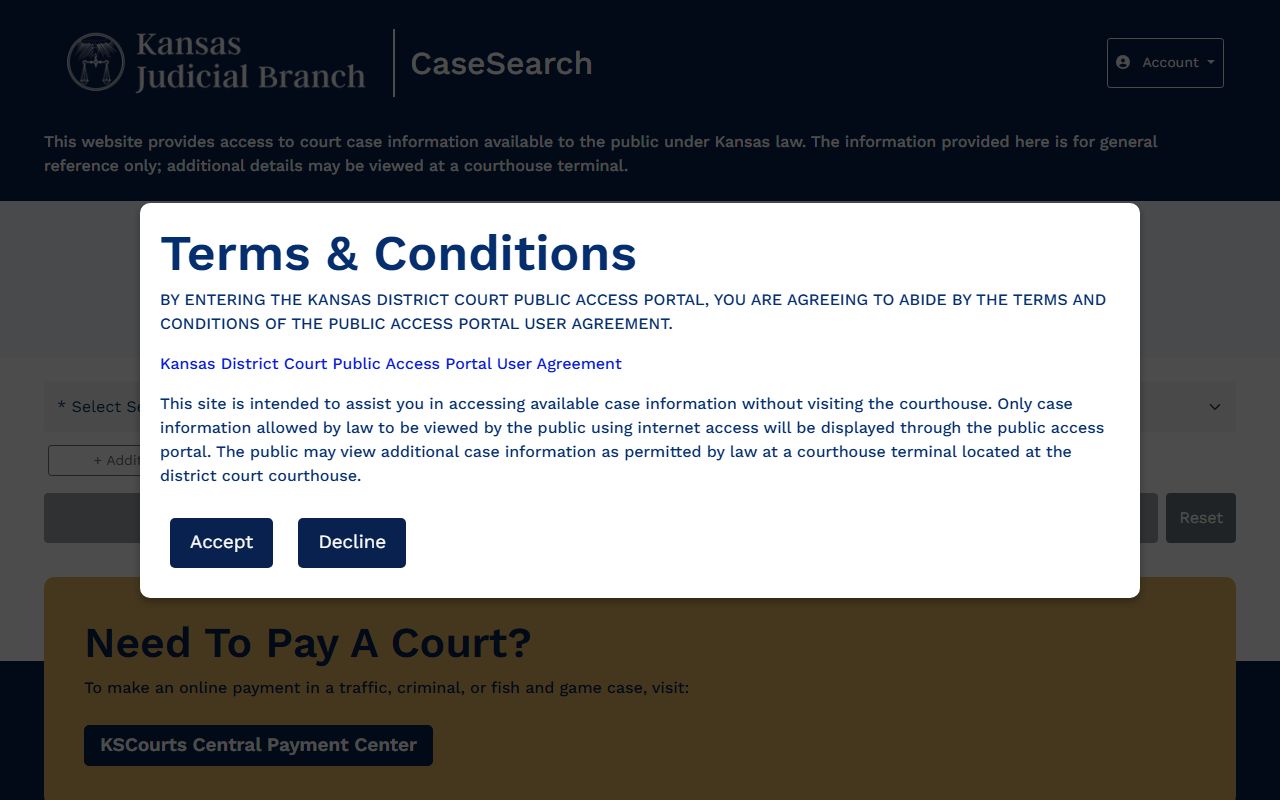
The Washington County District Court page links users to the Kansas District Court public access portal, known as Kansas CaseSearch. CaseSearch is the main online route for Washington County court records after a jail arrest once a case exists in the district court system. The portal can be searched by case number, party name, business name, citation, and other criteria that may depend on the user's role or access level. A person who only has jail booking information may need to search by defendant name first, then confirm the filing date, county, and charge list.
The official district court page identifies Washington County District Court at P.O. Box 235 in Washington, with clerk phone 785-325-3265 and weekday office hours split between morning and afternoon sessions. The same page lists Chief District Judge Kim W. Cudney and District Magistrate Judge Jason Cohorst. Those details matter because bond, first appearance, warrants, and later docket activity are court functions, not jail roster functions.
The Kansas CaseSearch portal is the official source shown by the district court page for public case lookup.
Use the portal for filed cases, not for a live list of people booked into the Washington County Jail.
| Search Field | Use For | Notes |
|---|---|---|
| Case number | Known court case | Best when bond paperwork, a citation, or the clerk provides the number. |
| Party name | Defendant search | Use full legal name and check spelling variants if no result appears. |
| Business name | Business party | Rare for a jail arrest, but available for other district court matters. |
| Citation | Traffic or citation case | Helpful when the arrest or charge began with a citation number. |
| Role-based fields | Expanded access | Some controls may vary based on user role or registration. |
Washington County Arrest Charge Filing
After a Washington County jail arrest, the prosecutor reviews law enforcement reports before the filed court charge is set. The County Attorney may file a charge that matches the arrest label, but it can also be amended, reduced, dismissed, or replaced as more facts are reviewed. A complaint is often used to start a Kansas criminal case. An information is a formal prosecutor-filed charging document. An indictment is a grand-jury charging document and is less common for routine local matters.
| Document | What It Does | Washington County Use |
|---|---|---|
| Complaint | Starts a criminal case with specific allegations. | Common first charging document after local arrest review. |
| Information | States formal charges filed by the prosecutor. | Often used in felony and misdemeanor prosecution tracks. |
| Indictment | States charges returned by a grand jury. | Less common for routine local jail arrests. |
The county attorney page is a useful source for office identity and prosecution scope, but it is not a live court docket.
When a filed charge differs from the jail intake label, the court record is the better source for the pending prosecution.
Washington County Charge Status
Charge status tells whether an accusation is still active and what happened to it in court. It does not prove guilt by itself. A pending charge may later be amended, dismissed, diverted, resolved by plea, tried, or sentenced. CaseSearch and the district court clerk can show docket entries when public access is allowed, but sealed records, juvenile records, protected victim information, and confidential filings may not appear to the public.
| Status | Meaning | Why It Matters |
|---|---|---|
| Pending | The charge is active and not yet resolved. | Future hearings, bond terms, or filings may still change the case. |
| Amended | The charge wording, level, or count changed. | Do not rely only on the original booking charge. |
| Dismissed | The charge was dropped by court action. | The arrest may still have a record unless cleared through a lawful process. |
| Convicted | A plea or verdict resolved the charge against the defendant. | Sentencing, probation, jail, or KDOC custody may follow. |
Bond After Washington County Arrest
Bond and release questions sit between the jail and the court. Washington County's jail information page does not publish an online bond portal, bond desk schedule, or bond fee table. The practical local route is to call the jail or sheriff at 785-325-2293 and ask whether bond has been set, what kind of bond is allowed, whether another hold exists, and where payment must be made. Inmate account deposit rules should not be treated as bond rules.
A cash bond means money or approved funds are posted under court rules. A surety bond uses a bonding company. A personal recognizance bond, often called a PR bond, releases the person on a promise to appear without full cash payment. A no-bond hold means money alone will not release the person. Holds can come from another county, probation or parole, KDOC, federal authorities, or immigration authorities.
| Bond or Hold | Plain Meaning |
|---|---|
| Cash bond | Money is posted as security for court appearance and compliance. |
| Surety bond | A licensed bonding company posts bond under its own agreement. |
| PR bond | Release based on a promise to return to court. |
| Detainer or hold | Another agency or court blocks release until its authority is resolved. |
Warrants and Washington County Arrest Records
No official Washington County, Kansas active warrant list was located on the county or sheriff site. For active custody or enforcement questions, use the Washington County Sheriff's Office at 785-325-2293. For court case history, bench warrants, missed court dates, or docket entries, use the Washington County District Court clerk at 785-325-3265 or search CaseSearch after a case exists. K.S.A. 22-2401 is the Kansas arrest-authority statute tied to warrant and probable-cause arrests.
A bench warrant is issued by a judge, often after failure to appear or failure to obey a court order. A fugitive warrant may come from another county or state. A probation or parole warrant may connect to KDOC or community supervision. A federal warrant belongs in federal channels. A person with a possible warrant should not rely on a website result alone, because appearing at a jail or courthouse without advice can lead to arrest.
Charges, Convictions, Sealed Records
Washington County court records after a jail arrest can contain accusations before any conviction exists. The distinction is important for records use. A charge is a claim filed in court. A conviction is a plea or verdict. Kansas public records law may allow access to some case information, but access is not the same thing as a finding of guilt. KBI criminal history checks are the better route for complete statewide criminal-history record checks.
| Issue | Charge | Conviction |
|---|---|---|
| Stage | Accusation filed after arrest review. | Final result after plea or verdict. |
| Proof | Based on probable cause and prosecution filing. | Resolved under the criminal burden of proof. |
| Record Use | Must be read as pending or unresolved unless updated. | May affect sentence, supervision, or custody status. |
Sealed and expunged records are also different. Research did not identify a Washington County-specific expungement instruction page, so the district court and Kansas law control eligibility and access. A sealed record is hidden from normal public access. An expunged record is treated differently under the court order that grants relief. Some law-enforcement or court uses may still be allowed by law.
| Issue | Sealed | Expunged |
|---|---|---|
| Public view | Restricted from ordinary public display. | Removed or limited under an expungement order. |
| Access | May remain available to certain officials. | Depends on Kansas law and the court order. |
| Next step | Ask the court clerk or an attorney about access. | Ask the court clerk or an attorney about eligibility. |
Kansas Access Limits After Arrest
The Kansas Open Records Act begins at K.S.A. 45-215. The records-not-required-to-be-disclosed section is K.S.A. 45-221, which includes criminal investigation records. The Kansas Attorney General's KORA FAQ says the front page of a standard offense report is open, while mug shots and standard arrest reports may be discretionarily closed under K.S.A. 45-221(a). That means a court record after arrest may be public even when a booking photo or some investigative material is not released.
For local report copies, the Washington County Sheriff's Office Reports/Request page posts a $10 fee for offense or incident reports and allows requests in person during office hours or by written request to the sheriff at 301 B Street. For filed court records, use CaseSearch or the district court clerk. For state custody after conviction, use KASPER. For federal cases, use the U.S. District Court for the District of Kansas and PACER rather than Kansas CaseSearch.